
Coastal Management in the Maldives: A Fight Against the Rising Sea


The Maldives, a nation of sun-drenched atolls and turquoise lagoons, is often depicted as an earthly paradise. Yet beneath its idyllic surface lies a harsh reality—this island country is engaged in a desperate struggle for survival against the encroaching sea. Comprising 1,190 low-lying coral islands scattered across the Indian Ocean, the Maldives holds the unenviable distinction of being the world's flattest country, with an average elevation of just 1.5 metres above sea level. This geographical vulnerability has transformed the archipelago into a global symbol of climate change impacts and a living laboratory for coastal management strategies. The Maldivian experience offers profound insights into the complex interactions between human ingenuity and environmental forces, where every decision about coastal protection carries existential consequences.
The Threats
The threats facing the Maldives are multiple and interlocking. Sea level rise, measured at 3–8 millimetres annually in the region, represents only part of the challenge. More immediately destructive are the increasing incidents of coastal erosion affecting 97% of inhabited islands, where some communities have watched helplessly as up to 10 metres of their shoreline disappear in a single year. Storm surges, intensified by more energetic monsoons and occasional cyclones, compound erosion and inundation risks. Saltwater intrusion increasingly contaminates freshwater lenses—vital for communities relying on groundwater—and threatens agriculture on islands where cultivable land is already scarce.
Compounding these problems, the coral reefs that form the archipelago’s natural defence system are suffering catastrophic bleaching events. The 2016 marine heatwave killed an estimated 60% of shallow-water corals, severely weakening the reef barrier that traditionally absorbed wave energy before it reached the islands. Subsequent bleaching events in 2020 and 2023 further eroded reef resilience. These environmental changes strike at the heart of the Maldivian economy: tourism contributes around 30% of GDP, drawing visitors primarily for its coral-rich waters and pristine beaches, while fishing remains the primary livelihood for many outer island communities. The capital Malé—one of the most densely populated places on Earth, with more than 66,000 people crammed into just 8 square kilometres—exemplifies the urgency. Here, the ocean is not a distant threat but a constant presence, lapping against the edges of a city that has nowhere to retreat.
Hard Engineering Responses

In response to these mounting pressures, the Maldives has become a testing ground for diverse coastal protection strategies, each with its own advantages and limitations. The most visible interventions fall under the category of hard engineering—substantial physical structures designed to resist the sea's power. These include seawalls, revetments, groynes, offshore breakwaters, and artificial islands constructed with elevated topography.
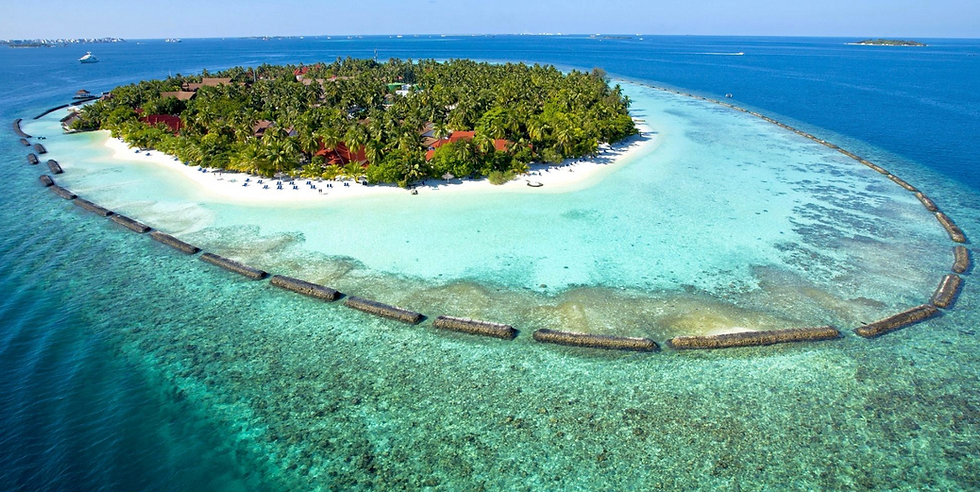
The iconic example is Malé’s 3-metre-high, 6-kilometre-long seawall, built in collaboration with Japan after the devastating 1987 storm surge that flooded one-third of the city. Constructed at a cost exceeding 300 million Maldivian Rufiyaa, the structure has since protected the capital from numerous coastal hazards. During the 2004 Indian Ocean tsunami, Malé suffered minor flooding compared with the catastrophic impacts across the region, largely due to this engineered perimeter.

More recently, the artificial island of Hulhumalé demonstrates the Maldives’ willingness to pursue large-scale engineered solutions. Reclaimed and elevated to around 2 metres above sea level, Hulhumalé is positioned as a “climate-resilient city” capable of hosting up to 240,000 people—an insurance policy should low-lying islands become uninhabitable. Its reinforced sea defences and elevated housing blocks mark a radical shift from traditional Maldivian urban design, reflecting a willingness to reconfigure landscapes in the face of rising seas.
However, such engineered solutions remain financially out of reach for most of the country’s 200 inhabited islands. Many smaller islands rely on simpler structures such as rock revetments or groynes. While these can slow erosion in targeted areas, they often redirect wave energy further down the coast, accelerating erosion elsewhere. Groynes may stabilise one beach by trapping sediment but starve another of replenishment. Revetments, although cheaper, reflect wave energy rather than dissipating it, intensifying scouring at their base. These knock-on effects highlight the inherent trade-offs of hard engineering in dynamic coastal systems.
Additionally, such structures can undermine local livelihoods and aesthetics. Seawalls may hinder recreational access to beaches, reduce their visual appeal for tourists, and disrupt sediment flows essential for maintaining the very beaches that visitors come to enjoy. As geography students will recognise, coastal protection rarely produces single, predictable outcomes; instead, interventions trigger cascading geomorphic responses that require ongoing management.
Soft Engineering and Nature-Based Solutions
Recognising the limitations of purely structural approaches, Maldivian authorities and environmental organisations have increasingly turned to soft engineering strategies that work with rather than against natural processes. These approaches aim to restore the ecosystems that naturally buffer the islands, offering more flexible, adaptive protection.
Beach nourishment has become a widely adopted strategy, particularly on resort islands where maintaining wide, sandy beaches is essential for tourism. Sand is dredged from nearby lagoons and pumped onto eroded shorelines, temporarily restoring beach width. While less intrusive than hard defences, nourishment is costly, requires continual repetition, and can disrupt benthic habitats through sediment disturbance. Nevertheless, it remains a pragmatic tool for buying time in high-value locations.

Coral reef restoration forms another critical element of soft engineering. Projects range from coral transplantation—where healthy fragments are attached to reef substrates—to advanced techniques such as mineral accretion, in which low-voltage electrical currents stimulate the deposition of limestone-like minerals onto metal structures, accelerating coral growth. Reef restoration sites near Baa Atoll, a UNESCO Biosphere Reserve, have shown promising recovery, although their scale remains modest compared with the vast reef areas affected by bleaching.

Mangrove rehabilitation, though limited to a handful of islands such as Fuvahmulah and Hithadhoo, offers multiple benefits. Mangroves stabilise shorelines by trapping sediment, reducing erosion, and absorbing wave energy. They also support biodiversity, acting as nurseries for fish species crucial to local fisheries. Importantly, mangroves sequester atmospheric carbon at rates far exceeding terrestrial forests, providing climate mitigation benefits. Yet these nature-based solutions face their own constraints: corals grow slowly, mangroves require decades to mature, and both remain vulnerable to warming waters, sea-level rise, and changing precipitation patterns.
Despite these limitations, nature-based approaches represent essential tools in the Maldivian coastal management toolkit. They align with broader international trends favouring “building with nature,” offering co-benefits that extend beyond physical protection to ecological restoration and community well-being.
Hybrid Approaches: The Safer Islands Strategy
The emerging consensus among coastal management experts suggests that neither hard nor soft engineering alone can provide adequate protection. Instead, hybrid systems that combine elements of both may offer the most sustainable path forward. The Maldives’ “Safer Islands” programme embodies this philosophy. Initiated after the 2004 tsunami, the programme identifies select islands for targeted investment in resilient infrastructure, including seawalls, elevated land, widened beaches, vegetated belts, and improved stormwater drainage.
This multi-layered defence approach mirrors concepts used in the Netherlands and Japan, adapted to the Maldivian context. For instance, some Safer Islands combine offshore breakwaters to reduce wave energy with beach nourishment behind them to maintain beach width. Others integrate raised causeways and elevated housing platforms with mangrove buffers. The recognition that different sections of coastline require tailored solutions reflects a nuanced understanding of coastal dynamics and the need for flexibility in the face of changing environmental pressures.
However, the Safer Islands strategy raises ethical questions. By prioritising investment in selected islands, is the government implicitly accepting that others may eventually be abandoned? Such difficult decisions highlight the tension between protecting population centres and preserving traditional island communities.
Managed Retreat and Novel Adaptation Pathways
Looking to the future, the Maldives confronts difficult questions that transcend conventional coastal management paradigms. With some climate models suggesting that much of the archipelago could become uninhabitable by 2100, concepts like managed retreat—the planned relocation of people from high-risk areas—have entered policy discussions. Retreat carries profound cultural implications in a nation where island identity is deeply embedded in heritage and community.
More radically, the government has partnered with Dutch engineering firms to explore floating urban developments that would rise with sea levels. The proposed Maldives Floating City, to be built in a lagoon near Malé, consists of interlinked floating platforms designed to mimic coral patterns and provide housing for up to 20,000 people. While technologically fascinating and potentially transformational, such solutions highlight the extraordinary costs climate-vulnerable nations may face simply to maintain their territorial integrity.
Ultimately, the Maldivian experience highlights the fact that even the most sophisticated coastal management strategies can only buy time against rising seas unless accompanied by meaningful global climate action. The country’s future hinges not only on local adaptation but on international commitments to reduce greenhouse gas emissions.
A Geographical Lens: Why the Maldives Matters
The Maldives presents a compelling case study that connects physical processes with human systems, local actions with global forces, and immediate solutions with long-term sustainability. The country’s challenges encapsulate key geographical concepts including:
systems thinking, as human and natural systems interact dynamically
risk and vulnerability, central to understanding climate change impacts
sustainable development, requiring careful balancing of economic, social, and environmental priorities
the Anthropocene, in which human activities drive environmental change at unprecedented scales
Perhaps most importantly, the Maldivian struggle demonstrates that coastal management isn’t merely an academic exercise—it is a matter of national survival where the stakes could not be higher. As students evaluate the relative merits of different strategies, they engage with questions that will define the 21st century: how humanity adapts to environmental change, and what obligations the global community bears towards those on the climate change frontlines.
Sources
IPCC Special Report on the Ocean and Cryosphere in a Changing Climate (2019)
Maldives National University, Centre for Sustainable Development (2022)
Ministry of Environment, Climate Change and Technology, Maldives (2021)
Nicholls, R.J. et al. (2018) Integrating Sea-Level Rise Adaptation into Coastal Development
Coral Reef Studies Journal, “Maldives Reef Resilience Project” (2023)
Dutch Water Sector Report on Maldives Floating City Project (2022)
United Nations Development Programme Maldives Country Report (2021)


Comments